Xiaomi Delivers on Tesla's Decade-Old Robot Charger Vision with New Home Robotic Arm
Xiaomi is moving to fulfill a hardware promise that Tesla left dormant for over a decade. The company has unveiled a home robotic arm charger designed to autonomously plug and unplug electric vehicles, realizing a concept that Tesla prototyped but never brought to market.
The history of this specific automation is defined by unfulfilled potential. In December 2014, Elon Musk described a charger that would move from a wall and connect like a "solid metal snake." Tesla demonstrated a functional, multi-segmented robotic arm prototype by August 2015. However, that technology stalled. While the concept was described as "not dead" as recently as 2020, Tesla eventually pivoted toward wireless charging and the design of the Cybercab. Even those efforts faced setbacks, as Tesla abandoned wireless charging for the Cybertruck because the vehicle sits too high off the ground.
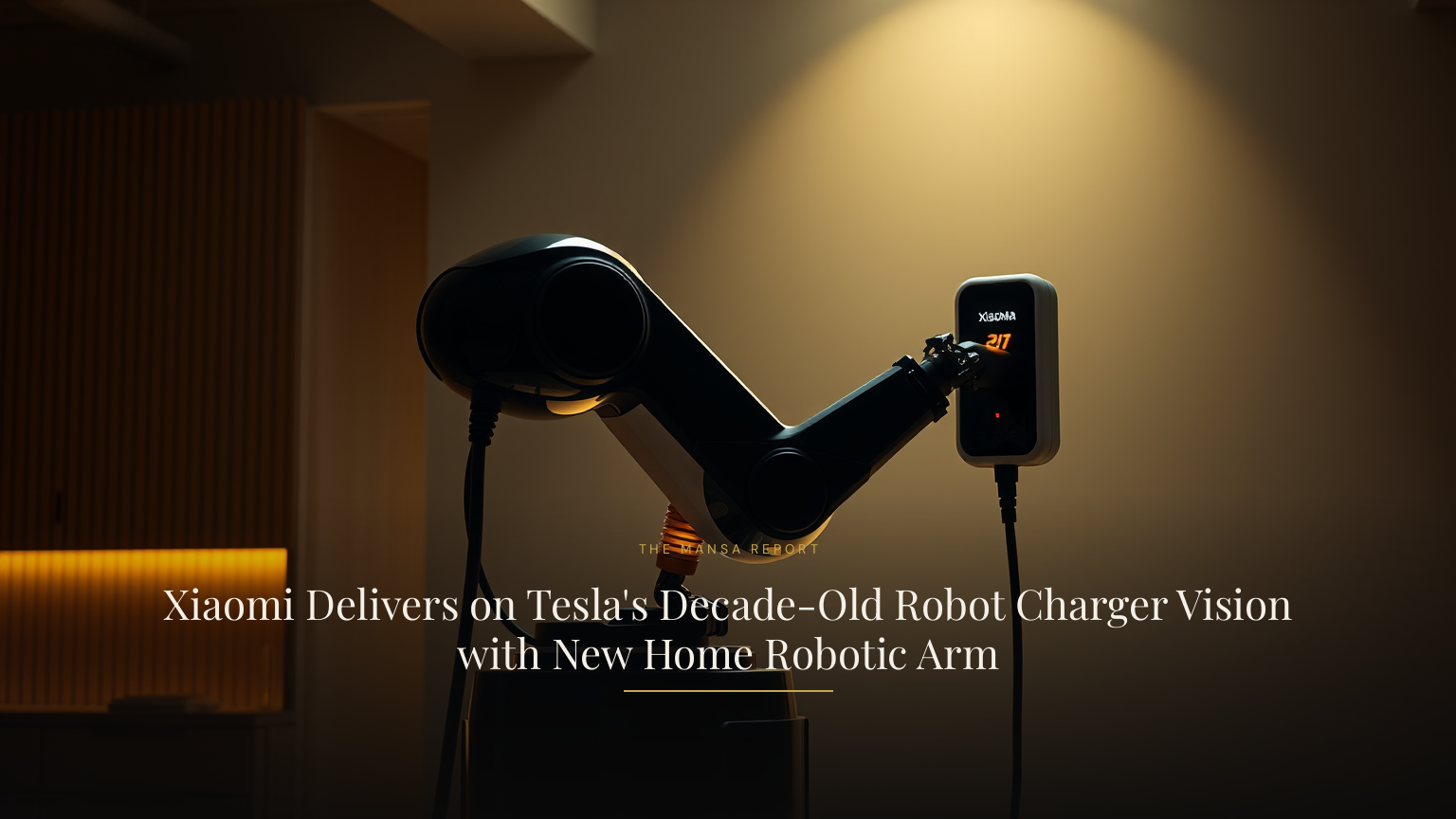
Xiaomi’s approach focuses on integration and spatial efficiency. On June 11, Xiaomi Auto released a demonstration of a robotic arm that mounts to a wall or floor. The device uses AI vision recognition to detect a vehicle's charge port and insert the connector with sub-millimeter precision. The system can even communicate with a vehicle to trigger motorized charge port covers.
The hardware is built for the constraints of residential infrastructure. The arm's housing is only 152 mm wide, allowing for installation in tight garage parking spaces. This device sits within the broader Xiaomi "human-car-home" ecosystem, allowing for smartphone-based remote control.
This launch expands Xiaomi's existing charging portfolio, which already includes 7 kW and 11 kW wallbox chargers and a portable charge/discharge gun. While the robotic arm is currently in the demonstration stage and lacks announced pricing or availability, Xiaomi is framing it as a product intended for the home market.
The significance here is not just the hardware, but the closing of a gap in the EV user experience. Tesla proved the concept was possible; Xiaomi is attempting to prove it is practical.
Watch for whether Xiaomi can move this from a demonstration video to a scalable consumer product.
Subscribe to The Mansa Report
Strategic intelligence on AI, business building, and the future of technology. Delivered Monday through Friday.