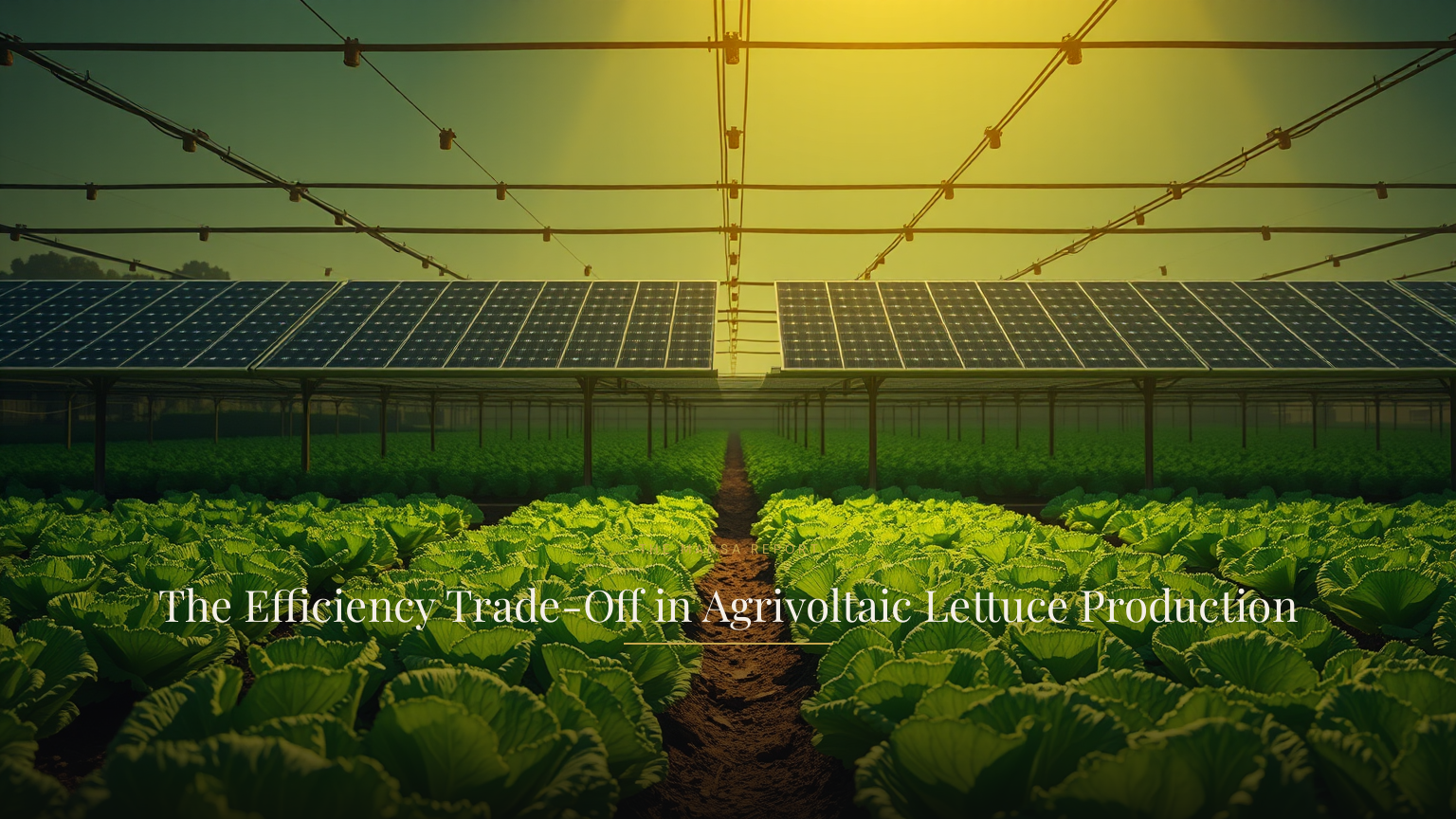
The Efficiency Trade-Off in Agrivoltaic Lettuce Production
The integration of advanced solar technology into agriculture is no longer just about land use; it is an optimization problem involving food, energy, and water. Researchers from Cornell University have conducted a “farm-to-fork” life-cycle assessment to evaluate how perovskite tandem PV technologies impact lettuce production in the United States.
The study compares perovskite-silicon (P-S) and perovskite-perovskite (P-P) tandem technologies against conventional silicon PV. By analyzing major US lettuce-growing regions—including California’s Central and Southern Coasts, the Southern Desert, the Central Valley, Arizona, and Florida—the researchers quantified how different solar configurations alter agricultural yields and resource consumption.
The data reveals a direct tension between energy density and crop output. Implementing full-density (FD) configurations reduces lettuce yields by 40%. Moving to half-density (HD) configurations drops yields by 20%, while single-axis tracking and dual-axis tracking reduce yields by 12% and 5%, respectively. However, these solar deployments offer significant water savings. The same configurations reduce irrigation demand by 50%, 30%, 30%, and 15%, respectively.
This suggests that the value of agrivoltaics may lie less in maximizing caloric output and more in mitigating resource scarcity. As climate volatility threatens irrigation stability, the ability to reduce water demand by up to 50% provides a hedge against drought, even at the cost of lower crop density.
The researchers also modeled various power conversion efficiencies (PCEs) for these emerging technologies. For P-S tandems, scenarios include PCEs of up to 25%, 30%, and 35%. For P-P tandems, scenarios are set at 25%, 30%, and 35%. The study further examined the impact of system lifetimes of 2, 5, and 10 years.
The implications for the energy transition are clear: the deployment of perovskite tandem PV in agriculture must be managed as an integrated food-energy-water system. Success will be measured by whether these modules can reduce greenhouse gas emissions and conserve water without making large-scale vegetable production economically unviable.
Can the water savings provided by high-density solar configurations offset the loss in agricultural yield in drought-prone regions?
Subscribe to The Mansa Report
Strategic intelligence on AI, business building, and the future of technology. Delivered Monday through Friday.