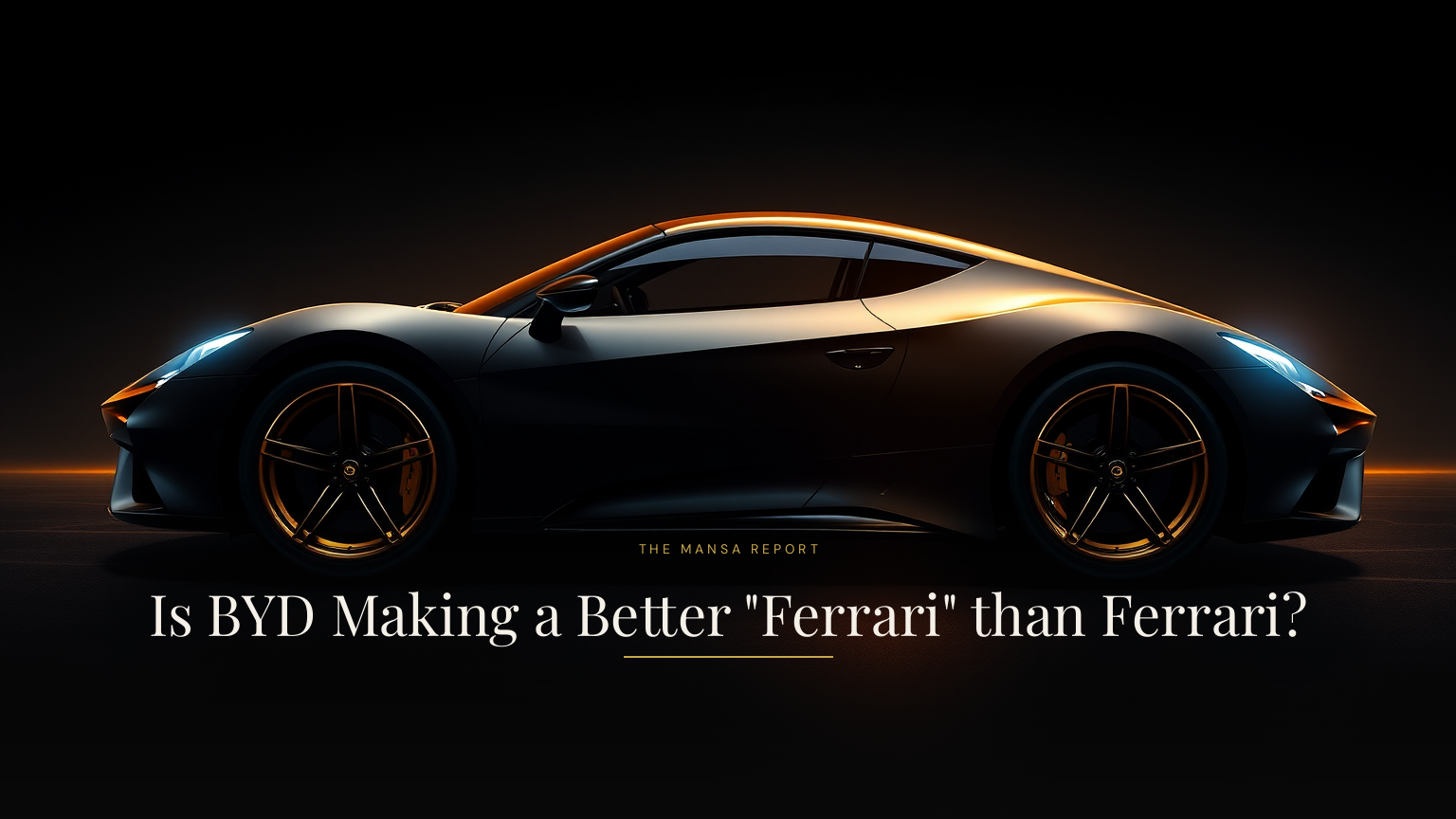
Is BYD Making a Better \"Ferrari\" than Ferrari?
BYD is moving aggressively into the high-performance luxury segment, challenging the traditional dominance of European marques with raw technical specifications. According to recent regulatory filings from the 408th monthly MIIT, the Denza Z is positioning itself as a direct competitor to the world's most storied sports cars.
The Denza Z is built around a massive power output. The vehicle features a 500 kW motor on the front axle and two 340 kW motors on the rear axle, delivering a total of 1180 kW (1582 horsepower). Performance metrics suggest a 0-100 km/h sprint of less than 2 seconds. Speed capabilities vary by model: the hardtop and convertible versions are listed at a top speed of 300 km/h, while the performance version reaches up to 350 km/h (217 mph).
The engineering focus extends to chassis and handling. The Denza Z utilizes four-wheel steering and a completely steer-by-wire system, paired with DiSus M active suspension to manage body motion. While specific battery capacity remains unannounced, the vehicle is expected to utilize 1000V architecture with BYD’s flash charging capability.
The physical footprint of the Denza Z is comparable to many current Ferrari sports cars, measuring 4780-4870 mm long and 1990 mm wide. Weight varies by configuration, with the hardtop at 2,220 kg and the convertible reaching up to 2290 kg. This mass is notable, yet not particularly heavy for EVs producing over 1000hp.
This shift in the luxury market creates a divergence in design philosophy. While BYD is doubling down on high-output, high-performance silhouettes, Ferrari is moving in a different direction with the Luce. The Luce adopts a tall sedan or short crossover layout, standing 60.8” tall—a height closer to a Model Y (63.9”) than a Model 3 (56.7”).
The implication is a widening gap between two different definitions of luxury. BYD is attempting to capture the enthusiast market through sheer mechanical force and advanced electrical architecture. Ferrari, conversely, appears to be prioritizing a new form factor that departs from the traditional sports car archetype.
The question for the high-end market is whether prestige will remain tied to the classic low-slung silhouette, or if the sheer performance density of 1000V electric platforms will make the traditional sports car obsolete.
Subscribe to The Mansa Report
Strategic intelligence on AI, business building, and the future of technology. Delivered Monday through Friday.