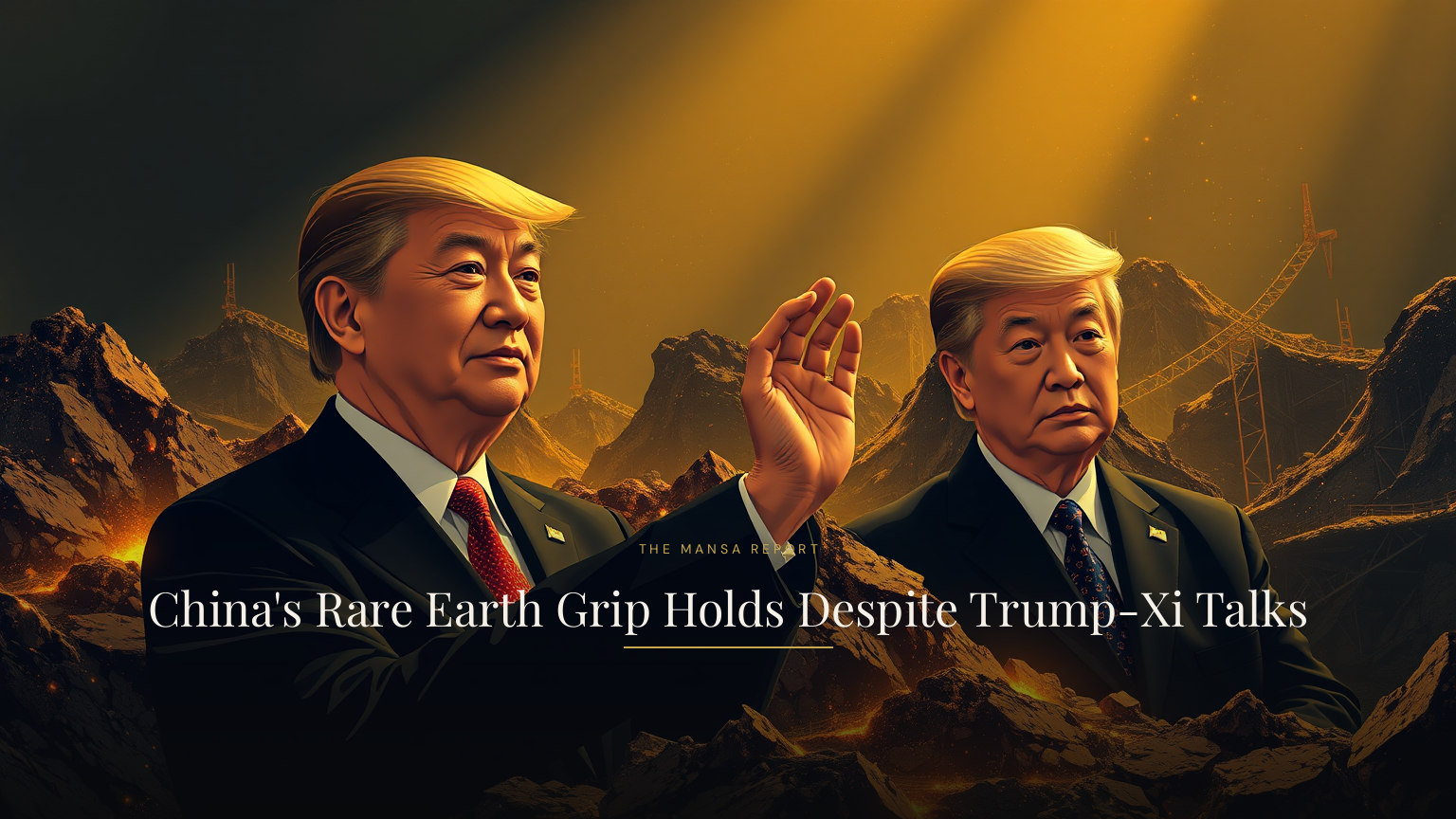
China's Rare Earth Grip Holds Despite Trump-Xi Talks
The recent two-day summit between Donald Trump and Xi Jinping ended with no formal agreement on China's export controls. While the White House stated Beijing committed to addressing U.S. concerns over supply shortages, the rare earth market remains unconvinced.
The structural reality of the supply chain is not changing. China controls roughly 60% of the world's mined rare earth output and near-total processing capacity. Following the tightening of controls in April 2025, which imposed export licensing requirements on seven medium and heavy rare earth elements, the impact on global shipments is measurable.
The data shows a sharp decline in the movement of critical minerals. Exports of yttrium, dysprosium, and terbium are running at 42%, 41%, and 49% respectively of volumes recorded in the 12 months before the restrictions. The volatility is already hitting the bottom line of high-tech industries. Yttrium—a key insulator in semiconductor manufacturing and a thermal barrier coating for turbine blades—has seen its price rise roughly 15-fold since the controls took effect.
This is a bottleneck problem with no immediate exit. As recently as 2023, China held 99% of global heavy rare earth processing capacity. With the only non-Chinese refinery—a small facility in Vietnam—currently offline due to a tax dispute, the West lacks the infrastructure to bypass Beijing.
The second wave of controls, which extended extraterritorial reach to products made anywhere using Chinese materials, was suspended for one year as part of a trade truce at the APEC summit in South Korea. However, that suspension expires in November 2026, and the April 2025 controls remain fully in force.
Washington is attempting to build a counterweight, but the scale of the challenge is immense. The Pentagon took a $400 million equity stake in MP Materials, yet the gap between these investment announcements and the establishment of an actual supply remains significant.
The era of cheap, frictionless access to these minerals is over. For the aerospace and chip industries, the focus must shift from seeking a quick fix to the long-term reality of a fragmented, high-cost supply chain.
How much capital is required to build a processing capacity that can actually compete with a 99% market share?
Subscribe to The Mansa Report
Strategic intelligence on AI, business building, and the future of technology. Delivered Monday through Friday.